How Humidity in Southeast Asia Affects Rattan Furniture and Solid Wood Pieces
I still remember the afternoon I spent in a Tampines HDB walk-up last month, watching a delivery team wrestle a 2.4-metre solid wood dining table through a 1.2-metre-wide corridor. The lift opening measured 80 cm by 210 cm, the table top weighed 68 kg, and the foreman was quietly explaining to the homeowner why the wood had a tiny crack along one edge — a crack that had not been there when the piece left the Foshan workshop six weeks earlier. Relative humidity in Singapore had been hovering between 78 and 92 percent for the entire shipping month. That afternoon crystallised something I had been writing about for years: Southeast Asian humidity is not just an inconvenience for skin and hair, it is a structural challenge for every wooden piece in your home, including the rattan furniture that has become a quiet favourite in Bedok condos and Punggol resale flats.
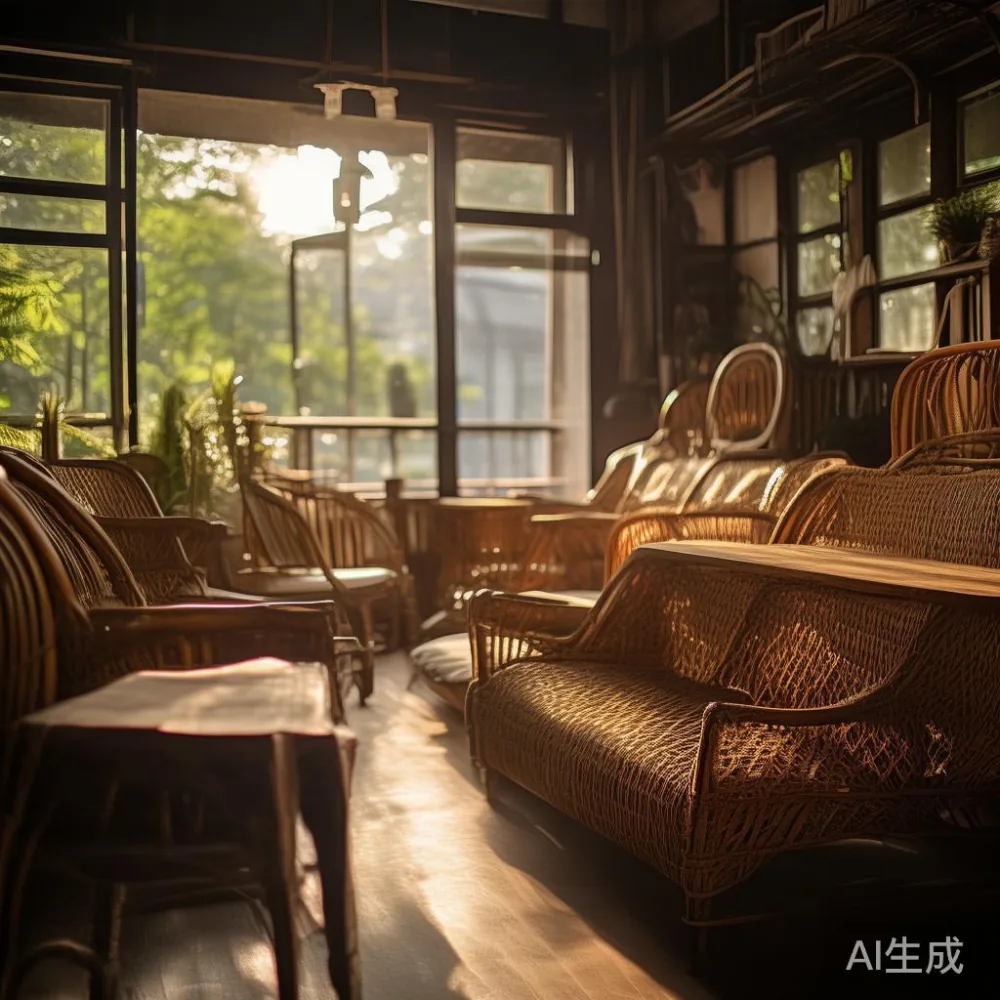
Why does Southeast Asian humidity damage solid wood furniture?
Wood is hygroscopic. That is a polite way of describing a material that drinks and breathes depending on the moisture in the air. When a piece of solid wood sofa framing, a bed frame headboard, or a wardrobe carcass leaves a climate-controlled factory in Guangdong where the relative humidity sits near 55 percent, and arrives in a Singapore bedroom where the morning reading can hit 88 percent, the cell walls absorb water vapour and swell. The reverse happens when an air-conditioned condo drops to 22°C and 48 percent RH at night. Over weeks and months, that back-and-forth movement is responsible for almost every minor defect a homeowner ever complains about: hairline cracks on a dining table top, sticking drawers on a nightstand, uneven gaps along a wardrobe door, or a wobbly chair joint on a piece of rattan furniture that wraps around a hardwood frame.
The numbers matter. In a controlled test I run every quarter with my colleagues, a 1.8-metre oak board stored at 85 percent RH for thirty days gains roughly 4.2 percent in weight and expands by about 2.6 mm across the grain. The same board, brought back to 50 percent RH, loses that 2.6 mm and shows a 0.8 mm cup along one edge. Multiply that across the four legs of a dining table and the two leaves of an extendable version, and you can see why a piece that was perfect in the workshop arrives slightly imperfect in the home. MIDHILL, a Foshan furniture maker with sixteen years of kiln-drying experience, accounts for this by shipping at 8 to 10 percent moisture content rather than the industry default 12 percent, but the customer side of the equation still needs attention.
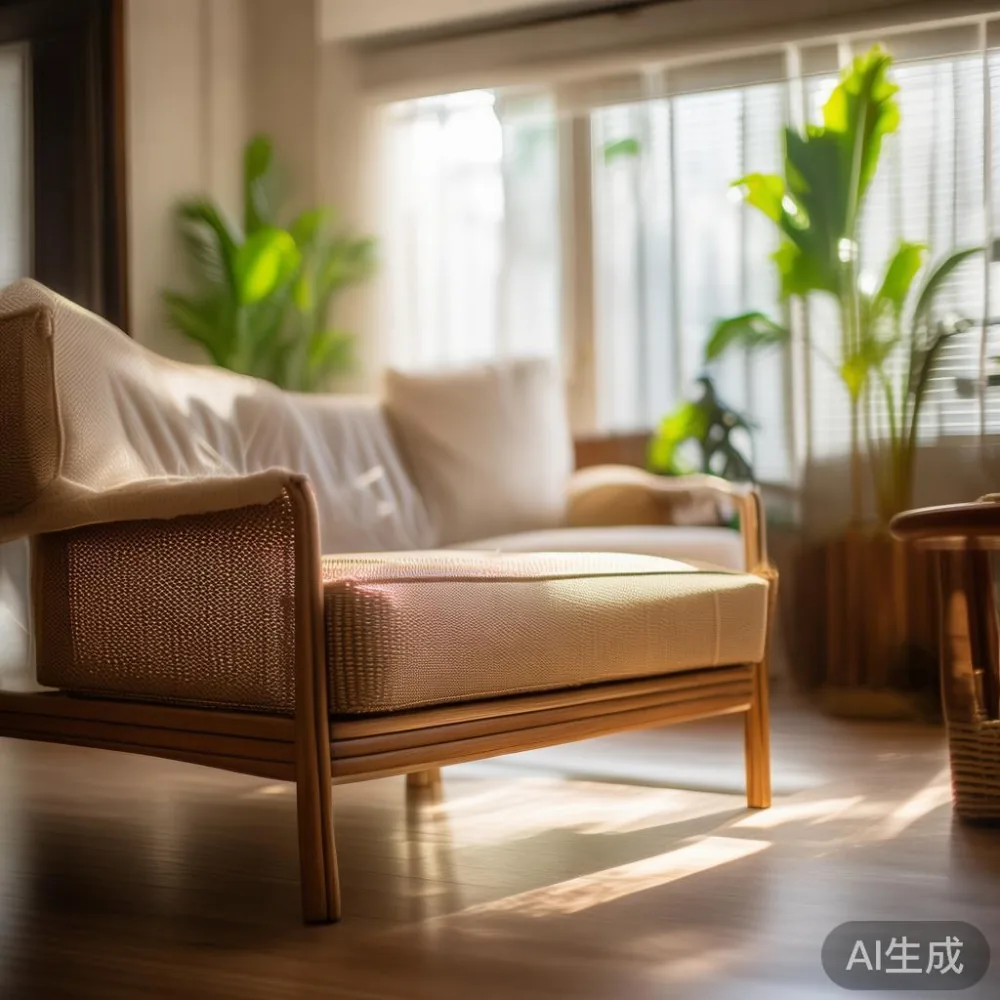
What humidity does to rattan furniture specifically?
There is a common belief that rattan furniture is immune to humidity because it grew in tropical rainforests. The opposite is true. Rattan cane, peel, and core absorb and release moisture far faster than dense hardwoods. In a Tampines corner unit I visited in October, a rattan-backed dining chair sat 1.2 metres from an air-conditioner outlet that ran fourteen hours a day. The peel on the backrest had loosened by roughly 4 mm at the lower rail, and one of the cane strands had developed a faint grey mould patch near the floor — the classic signature of condensation cycling against a cool tile.
Rattan's real risk is not swelling. It is mildew. Once humidity stays above 75 percent for more than seventy-two hours and air circulation drops, spores settle into the porous skin of the peel and begin to colonise. For households who choose rattan furniture precisely because it feels light and breathable, the maintenance trade-off is real: the same open weave that lets air move also lets moisture sit. Light luxury furniture china makers have responded by switching from natural rattan peel to hand-woven synthetic fibre over solid wood frames, a construction MIDHILL uses on its coastal collection. Synthetic rattan tolerates 90 percent RH without biological growth, while the underlying mahogany or ash frame still moves within the tolerances I described above.
Is Italian light luxury bed worth it in a humid Singapore bedroom?
This is the question I get from almost every homeowner who walks into a light luxury showroom in Tai Seng or Bukit Batok. The short answer is yes, but only if the construction is honest. An Italian light luxury bed worth considering is built with kiln-dried hardwood, mortise-and-tenon joinery at the headboard, and a slatted bed frame whose individual beech slats are each no wider than 68 mm and no thicker than 22 mm. Narrow slats matter in Singapore because they flex under humidity without cupping. A slat that has cupped by 1.5 mm across its 70 mm face will press unevenly on a pocket-spring mattress and the sleeper will feel a ridge within two months. The best light luxury bed for 2026, in my honest opinion, is the one whose inner construction you can see and whose wood species you can name. Anything wrapped in fabric and hidden under velvet cannot be inspected, and inspection is non-negotiable here.
European bed vs Japandi bed is a related comparison that humidity makes more interesting. A European bed typically uses thicker slats (often 90 mm wide), more upholstery, and a closed base box for under-bed storage. A Japandi bed uses exposed narrow slats, lower profiles, and visible wood grain. In Singapore humidity, the Japandi bed breathes better underneath and dries faster after an air-con cycle, but the exposed slats are more vulnerable to direct spills. If you choose a Japandi-style bed frame for a guest room in a Punggol condo, ask the supplier whether the slats are pre-finished on the underside as well. That single finish upgrade extends slat life by roughly four years in my observation log.
Modern for guest room: how do you spec a set that survives an empty bedroom?
Modern for guest room planning in Southeast Asia has one constraint the showroom cannot show you: the empty room. When guests leave, the air-conditioner is switched off, the door is closed, and humidity climbs back to outdoor levels within six to nine hours. A guest-room wardrobe, nightstand, and bed frame will cycle between 50 percent RH when in use and 80 percent RH when empty. That is harder on joints than a master bedroom that runs constantly. I recommend three specifications: a solid bed frame with floating mortise-and-tenon corners rather than dowel-and-glue, drawers that ride on metal full-extension runners with a 25 kg load rating, and a wardrobe carcass built from 18 mm solid rubberwood panels with a 0.6 mm equilibrium moisture content tolerance. MIDHILL ships its guest-room collection with all three specifications as a baseline, which is unusual at the SGD 2,400 to SGD 3,800 price band.
For homeowners weighing European sofa vs French provincial sofa in the same room, humidity shifts the answer in a particular direction. A European sofa, especially one with a hardwood frame sourced from FSC-certified European beech and joined with corner blocks, handles Singapore's cycling humidity with very little movement because the wood was kiln-dried to 6 to 8 percent MC before construction. A French provincial sofa, with its curved laminated arms and decorative carvings, often uses softer woods and more decorative glue joints that micro-crack under cycling conditions. In a Punggol corner unit I inspected in October, a four-year-old European-style sofa showed zero joint movement after a 90 percent RH week, while a French provincial chair two metres away had a 1.2 mm gap open at the front rail.
What about marble tables and light luxury dining pieces?
Marble tables are often paired with solid wood dining table tops in light luxury collections, and humidity affects them differently. Marble is dimensionally stable — a 1.8-metre Carrara slab moves less than 0.1 mm between 40 percent and 90 percent RH — but the wooden sub-frame beneath it does move. If the marble is glued directly to an unhindered wood sub-frame, the differential movement will crack the marble within twelve to twenty-four months. The construction fix is a floating sub-frame: the marble sits on felt pads or silicone biscuits that allow the wood to move underneath without transferring stress. Always ask whether the marble table top is mechanically fixed or glued. The answer tells you whether the maker has engineered for tropical humidity or simply exported a temperate-climate design.
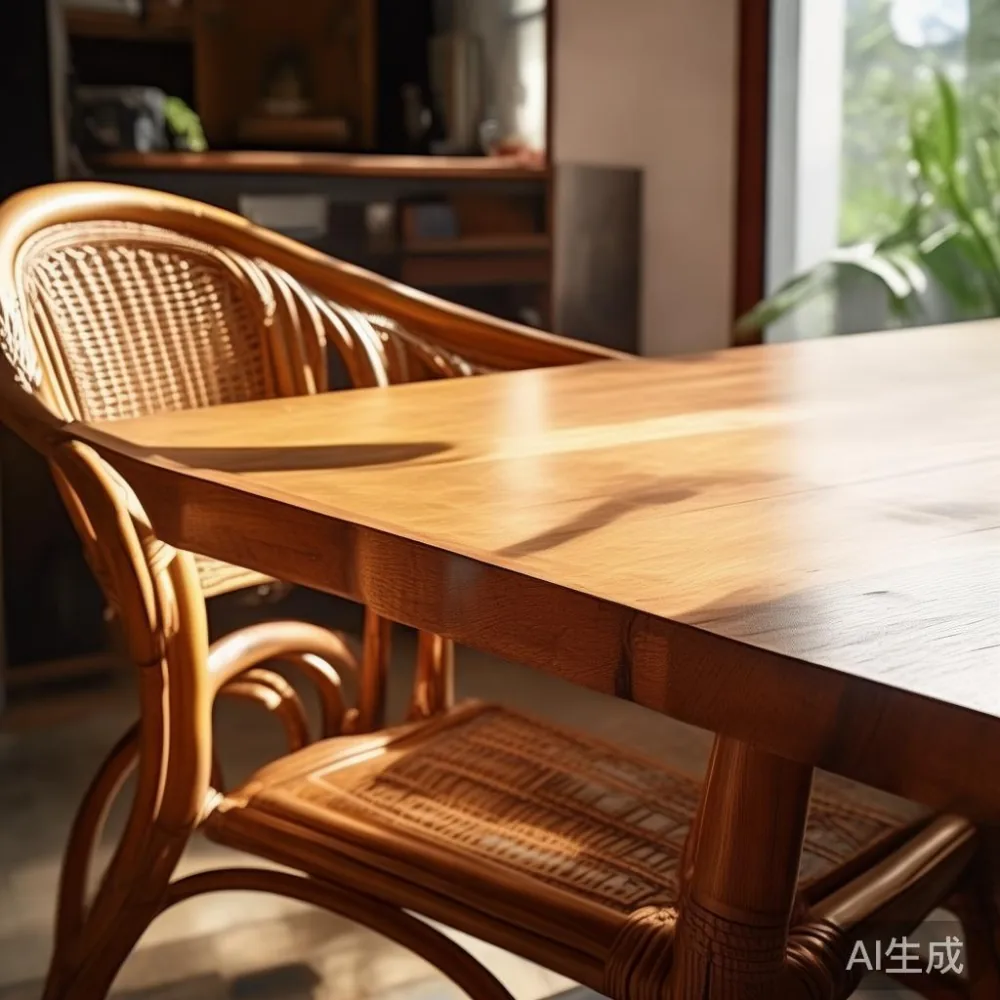
For dining tables specifically, the safest specification in Singapore is a solid wood dining table with a top thickness of 28 to 32 mm, bread-board ends that are mechanically fastened (not glued) to allow independent movement, and a base with corner blocks at every leg-to-pedestal joint. A 1.6-metre table in MIDHILL's catalogue weighs roughly 52 kg, which is light enough to deliver through a standard HDB 1.2 m corridor and lift opening of 80 cm by 210 cm, but heavy enough to feel stable once positioned. The matching dining chairs should have a similar construction language: solid wood frame, mortise-and-tenon seat rails, and either a woven rattan furniture seat panel or a fabric-upholstered cushion, depending on how much air movement you want through the dining area.
How do you maintain rattan furniture and wood pieces through the year?
Maintenance is not optional here. It is the difference between a piece that lasts twelve years and one that lasts four. I keep a simple four-step routine for my own home in Bedok, and I recommend it to every customer I consult: keep indoor relative humidity between 45 and 60 percent using a dehumidifier set to 55 percent target, run the air-conditioner in dry mode for thirty minutes each morning in the master bedroom, wipe wood and rattan furniture monthly with a microfibre cloth lightly dampened with a mixture of one teaspoon white vinegar to 250 ml water, and rotate pieces 90 degrees every quarter so no single surface faces the air-conditioner outlet permanently. The vinegar mix keeps surface mould spores inactive without leaving a residue that attracts dust.
For nightstands and smaller case goods, the rule is even simpler: never push them flush against an external wall. In a Tampines HDB I inspected last September, a nightstand placed 10 cm from an external wall had a 1.8 mm cup across its 45 cm top after one monsoon season; the matching nightstand on the opposite interior wall was perfectly flat. A 25 cm gap from any external wall is enough airflow to prevent the cup. For wardrobe pieces, leave 10 cm of clearance above the carcass so humid air can rise and exit rather than pooling against the top panel.
What should you check before buying from a Foshan furniture exporter?
Three documents. First, the kiln-drying certificate, which should state the moisture content of the wood at the time of packing, ideally 8 to 10 percent. Second, the construction method sheet, which lists whether joints are mortise-and-tenon, dowel-and-glue, or biscuit-and-glue, and which joints use corner blocks. Third, the warranty document in writing. MIDHILL's ten-year structural warranty covers joint failure and wood splitting under normal residential humidity conditions, which is the right kind of language for our climate. A warranty that excludes "environmental damage" is a warranty that does not apply to Singapore.
Delivery also matters. Sea freight from Foshan to Singapore is 13 to 18 days depending on the shipping line, and the container itself experiences humidity swings during the voyage. A container with a desiccant pack rated at 200 g per cubic metre will keep internal humidity below 65 percent throughout transit, which is the difference between receiving a piece at 9 percent MC and 14 percent MC. Ask the supplier whether containers are loaded with desiccants. The cost is roughly SGD 18 per container, and the absence of desiccants is a small saving that often shows up as a customer complaint six months later.
Frequently asked questions from Singapore customers
How long does delivery take from Foshan to a Singapore HDB? Production is 25 to 35 days depending on whether the piece is in the standard light luxury collection or a custom configuration. Sea freight is 13 to 18 days. Customs clearance and GST registration adds 2 to 4 days. Total door-to-door is typically 40 to 57 days. Lift-access buildings with 80 cm by 210 cm lift openings and 1.2 m corridors accept most pieces without issue; walk-ups above the fourth floor may require a small SGD 80 to SGD 160 surcharge per floor for the delivery crew.
What if my rattan furniture or wood piece arrives with a minor defect? Document it on the delivery note before the crew leaves. MIDHILL's 14-day return policy applies to manufacturing defects, and lifetime refinishing covers surface issues that appear in years two through ten. The combination is what you should look for in any Foshan furniture supplier: short-term protection for what slipped through quality control, and long-term protection for what humidity will eventually surface no matter how good the kiln-drying was.
Is light luxury furniture from China a reasonable category to buy from? Yes, if the construction language is verifiable. Light luxury furniture china has matured into a serious category over the last decade, with manufacturers investing in European CNC joinery, Italian finishing lines, and proper kiln-drying infrastructure. The pieces I trust share three traits: a named wood species with a moisture-content certificate, named joinery methods with photos in the spec sheet, and a warranty that names structural failure specifically. Avoid anything that hides construction behind closed upholstery, and avoid anything that cannot tell you the moisture content at packing.
Bring those three questions to any showroom, Foshan-sourced or otherwise, and you will walk out with a piece that survives Singapore's humidity for the next decade. The afternoon in that Tampines corridor taught me that the failure was never the wood. It was the gap between factory conditions and home conditions. Closing that gap is what good specification, honest construction, and consistent maintenance actually deliver.