Caring for Lacquered Surfaces in a Tropical Climate
Living in Singapore means living with the weather. The relative humidity hovers between 70% and 85% for most of the year, afternoon temperatures climb past 32°C in HDB estates from Tampines to Bedok, and the occasional monsoon burst pushes moisture levels even higher. If you own a lacquered rattan wardrobe, a rattan dining table with a lacquered top, or any piece where a clear coat meets natural rattan weave, the climate becomes a daily consideration rather than a background detail. Last month, I visited a 1,100 sq ft Punggol condo where the owner had placed a five-seater rattan sofa just 1.2 metres from a floor-to-ceiling window facing west. Within fourteen weeks, the lacquer on the armrest had turned a milky white. The cause was not the sun alone; it was the combination of UV exposure, ambient humidity, and skin oils transferred from daily contact.
Solid wood furniture with lacquer finishes behaves differently in Singapore than in temperate cities such as London or Toronto. The wood absorbs and releases moisture at a faster rate, and the lacquer film expands and contracts with greater amplitude. Understanding this rhythm is the foundation of every maintenance habit I will describe below. Whether you are shopping for a MIDHILL light luxury sofa at S$2,180, comparing a European light luxury nightstand at S$460 against a minimalist Chinese equivalent, or simply trying to preserve a beloved inherited piece, the principles remain identical.
Why Does Singapore's Climate Attack Lacquer So Aggressively?
Lacquer is in effect a thin polymer skin, usually nitrocellulose or acid-cured alkyd, applied in six to ten coats and polished between rounds. Each coat is roughly 0.05 mm thick, so a finished surface carries about 0.5 mm of protective film above the wood or rattan core. Under Singapore's conditions, three forces act on that film simultaneously.
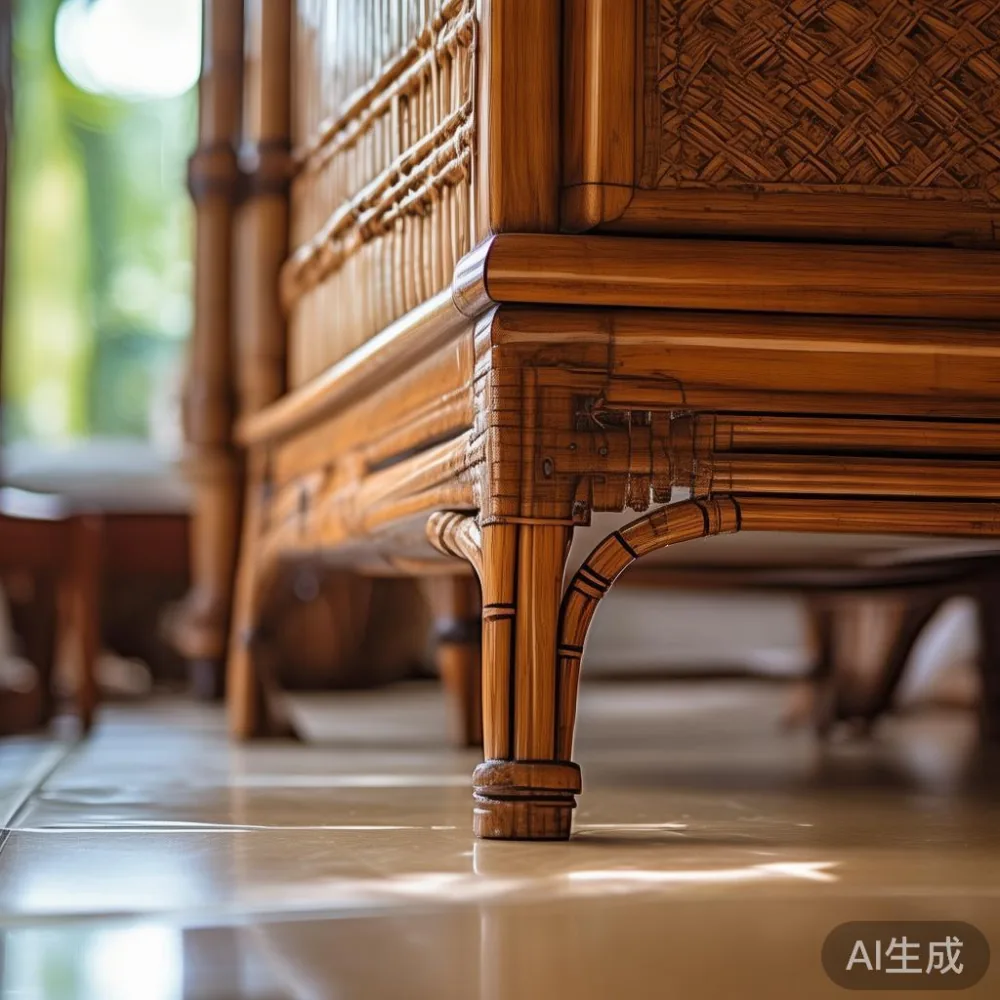
First, humidity. Rattan fibres are hygroscopic, meaning they absorb and release moisture until they reach equilibrium with the air. When humidity swings from 80% during a wet spell to 55% on a dry air-conditioned afternoon, the rattan core swells and shrinks by as much as 2% across its width. The lacquer, being less porous, cannot keep pace. Hairline cracks appear, usually at the joints where a rattan column meets a solid wood sofa frame, and once those cracks exist, moisture migrates underneath and lifts the lacquer in small bubbles known as blush.
Second, heat. Direct afternoon sun through a Tampines HDB window can push the surface temperature of a dark-stained rattan bed frame to 48°C. Most lacquers are formulated to tolerate 40°C for short periods, so prolonged exposure softens the film and invites fingerprints to embed themselves permanently.
Third, salt and pollutants. Singapore's coastal breezes carry fine salt crystals and haze particles that settle on every horizontal surface. Salt is hygroscopic; it pulls moisture out of the air and deposits it directly on the lacquer, accelerating the micro-crazing effect.
What Daily Habits Actually Protect a Lacquered Rattan Furniture Piece?
The maintenance routine for a lacquered rattan coffee table or dining table is simpler than most people expect. You need four items: two microfibre cloths (one dry, one damp), a pH-neutral wood cleaner, a soft-bristle vacuum brush, and a small hygrometer costing about S$18 from any Tampines Mall hardware shop.
Wipe the surface once a week with the dry microfibre cloth using long, parallel strokes that follow the grain of the underlying wood. Avoid circular scrubbing, which creates micro-abrasions visible under raking light. For a sticky residue such as soy sauce or kopi spills, mist the damp cloth with the pH-neutral cleaner and wipe gently within ninety seconds. Lacquer begins to soften when wet for longer than two minutes, so speed matters.
Vacuum the rattan weave twice a month using the soft-bristle attachment held no closer than 2 cm from the surface. Direct contact can snag the weave and loosen the binding where rattan meets the solid wood dining table apron. If you own a wardrobe or tall cabinet, pay special attention to the lower 30 cm, where dust accumulates from foot traffic in HDB corridors.
Monitor your indoor humidity with the hygrometer. Aim to keep the reading between 45% and 60%. Running the air-conditioning unit for at least four hours a day usually achieves this; if not, a small dehumidifier rated at 8 litres per day costs around S$189 and runs quietly enough for bedrooms.
How Should You Place a Rattan Sofa or Bed Frame Inside a Singapore Home?
Placement is half the battle. Before you even unbox a new solid wood sofa or bed frame, measure the lift opening and the corridor width of your HDB block. Most BTO lifts in Punggol and Sengkang have an internal width of 1.1 m and a depth of 1.4 m, which means any piece deeper than 1.3 m will require a tilting carry. MIDHILL, the Foshan-based manufacturer I have worked with for several projects, packs its largest lacquered pieces flat in cartons measuring 0.55 m by 0.55 m by 1.95 m for this very reason. Once the piece is inside the home, choose its permanent spot with care.
Keep lacquered rattan furniture at least 1.5 m away from any window that receives direct sunlight between 1 pm and 4 pm. If your condo faces north or south, this is rarely an issue; if it faces west, consider installing a UV-filtering film at S$22 per square foot installed. The film blocks 99% of UVB and roughly 70% of UVA, the spectrum responsible for the ambering of clear lacquer.
Maintain a 5 cm gap between the back of any wardrobe or tall cabinet and the wall. This allows air circulation and prevents the wall's slightly higher moisture content from transferring into the lacquer edge. Avoid placing rattan furniture against external walls that face the monsoon side of the building; those walls can sweat during heavy rain and the condensation will wick into the unsealed back panels.
For a rattan dining table, rotate the position 90 degrees every two months so that one quadrant does not absorb more light than the others. This keeps the patina even, particularly on pieces finished in French light luxury ivory or post-modern light luxury champagne tones.
Which Cleaning Products Are Safe for a Lacquer Finish?
This is the question I receive most often from clients in Bedok and Hougang, so let me answer it directly. The safest products are pH-neutral, water-based, and free of silicones, ammonia, and bleach. The furniture-care aisle at any Cold Storage outlet carries three or four qualifying options. A 250 ml spray bottle typically costs between S$12 and S$28.
Avoid the following household items at all costs: window cleaner containing ammonia, silicone-based polishes such as many aerosol sprays, magic eraser sponges (they are micro-abrasive and will strip lacquer within three passes), vinegar solutions stronger than 5%, and any wax product labelled for wooden floors. These products either soften the film, leave a permanent smear, or clog the rattan weave so it cannot breathe.
If you are weighing cheap European light luxury furniture against a local alternative, ask the supplier for the lacquer specification sheet. A credible European light luxury nightstand will list the coating type (often a conversion varnish or acid-catalysed lacquer), the number of coats (eight or more for premium European pieces), and the gloss level measured in Gardner units between 8 and 25 for a satin finish. If the seller cannot produce this sheet, walk away regardless of price. When you compare a European sofa vs Modern sofa on specifications alone, the European style typically uses a closed-pore filler system that resists Singapore humidity better than the open-pore finishes common on cheaper Modern sofas.
How Do You Handle Spills, Stains, and the Annual Monsoon Burst?
Spill response is a reflex, and reflexes must be trained. The clock starts the moment liquid touches the lacquer. Within the first ten seconds, blot, do not wipe. Wiping pushes the liquid sideways and expands the affected area. Use a dry microfibre cloth with light pressure and a 1 cm overhang beyond the stain to catch capillary spread.
For kopi, tea, or soy sauce, follow the blot with a single pass of a damp microfibre cloth. Dry the area within ninety seconds using the second cloth. The tannins in tea and coffee are the most aggressive; they can permanently dye a lacquer film within twenty minutes if ignored.
For candle wax, place a brown paper bag (an empty grocery bag works) over the wax and press with a warm iron set to the lowest setting. The wax melts into the bag rather than deeper into the lacquer. Never use a hairdryer; the focused heat will cloud the surrounding area.
The annual monsoon period, usually December through early March, brings sustained humidity above 85% for three to four weeks at a stretch. During this window, run your dehumidifier for at least eight hours a day, even in unused rooms, and keep wardrobe doors slightly ajar (2 cm is enough) to allow air exchange. I helped a client in Punggol through the 2024 monsoon whose lacquered rattan wardrobe developed blush marks on the lower panels because the wardrobe sat flush against an exterior wall. We moved the piece 4 cm forward, added felt pads at the base, and the marks have not returned.
How Long Should a Lacquered Rattan Furniture Piece Last in Singapore?
A well-maintained lacquered rattan sofa, dining table, wardrobe, or nightstand should deliver fifteen to twenty-five years of service in Singapore before the finish requires professional refinishing. The solid wood frame, if kept dry, can last sixty years or more. Refinishing is straightforward: the piece is sanded with 320-grit paper, degummed with a tack cloth, and recoated with seven fresh layers of nitrocellulose lacquer. Each coat is polished with 600-grit wet-and-dry paper and a fine rubbing compound. MIDHILL offers this service for pieces purchased through their Singapore distributor network, with a typical turnaround of fourteen working days and a cost of roughly S$28 per square metre of surface area, which is sensible compared with replacing a similar piece retail.
Between full refinishings, you can extend the surface life by applying a thin coat of paste wax every eighteen months. Use a clear, non-silicon wax such as a beeswax-carnauba blend, apply with a clean cotton cloth, let haze for twenty minutes, then buff with a microfibre cloth. This sacrificial layer absorbs UV and micro-scratches, taking the punishment instead of the lacquer underneath.
Among the best Industrial sofa for 2026 candidates, the lacquered rattan frames with powder-coated steel bases are increasingly common, blending the toughness of industrial design with the warmth of rattan weave. If you choose one of these hybrids, expect the rattan to need a touch-up every eight to ten years while the steel base remains unchanged. The same logic applies to a marble table with a rattan-inlaid apron, except that the marble needs only a periodic sealing rather than a refinishing.
What Common Mistakes Should Singapore Buyers Avoid?
I keep a running list of avoidable errors drawn from the condo and HDB flats I visit for client consultations. Sharing them here may save you the cost of a premature refinishing.
Placing a hot pot or a freshly boiled kettle directly on the rattan dining table without a trivet. A temperature shock of 90°C in under three seconds will leave a white ring that no amount of buffing will remove. Invest in a set of felt-lined cork trivets; a four-piece set costs around S$14.
Using a wet tea towel as a table covering during a steamboat dinner. The trapped steam softens the lacquer and dyes the wood beneath. Use a rigid plastic or melamine tray instead.
Dragging a rattan sofa across a vinyl or tiled floor. The vibration loosens the rattan-to-frame bindings and scratches the floor. Lift or use furniture sliders at S$9.90 per set of four. If you can no longer lift a piece because it is too heavy (a three-seater rattan sofa can weigh 42 kg), disassemble it into modules first; most MIDHILL designs ship with bolt-through construction that can be undone with a single 12 mm wrench.
Assuming that all rattan furniture is rattan furniture. There is a difference between natural rattan, which is the processed stem of the Calamus palm and behaves as I have described, and PE rattan, a polyethylene fibre used in outdoor pieces. PE rattan does not absorb moisture, but it also does not accept lacquer in the same way. The care advice in this article applies to natural rattan pieces. PE rattan furniture can simply be hosed down. For a top 10 light luxury furniture list relevant to Singapore buyers, natural rattan pieces finished with closed-pore lacquers usually rank in the upper half because of their longevity in the local climate.
How Do You Decide When to Call a Professional?
Some signs indicate that a piece needs more than a careful wipe-down. Cloudy patches larger than a 50-cent coin, a network of hairline cracks known as crazing, lifting edges along the rattan-to-frame joints, or a sticky surface that never fully dries all point to lacquer failure rather than surface dirt. In those cases, a professional refinisher can usually restore the piece without disassembly. A house call for assessment costs around S$60 within central Singapore and S$90 for the eastern estates, with any subsequent work quoted separately.
If the piece is still under warranty, contact the original supplier first. Quality manufacturers stand behind their finishes; a 10-year structural warranty covering frame integrity and lacquer adhesion is now standard among serious exporters, and a lifetime refinishing offer is a strong signal that the maker intends the piece to outlive the warranty period by decades. Midhill and a small number of similar Foshan factories offer this combination, and the practice has become a quiet benchmark for the category.
Finally, keep your purchase documents, the lacquer specification sheet, and two or three microfibre cloths with the piece. Future-you, or the next owner, will appreciate the head start. Singapore homes are tough on furniture, but with a fifteen-minute weekly habit and a few thoughtful placement decisions, a lacquered rattan wardrobe or dining table can become an heirloom rather than a five-year purchase.