Solid Wood vs Veneer Over 5 Years: A Singapore HDB Cost Reality Check
Buying a new dining table or wardrobe for your Tampines or Punggol flat usually starts with one question: solid wood or veneer? On the showroom floor, the price gap looks small. Over five years, that gap widens into a chasm. I watched this play out in a friend's Bedok resale HDB last month, where I helped her move a three-year-old veneer dining table out for disposal. The top had peeled near the window where afternoon sun hits daily, and one leg had swollen from a small leak under the kitchen sink. We carried it down a 1.2 m wide corridor, scraped the lift door frame, and paid a S$60 disposal fee. The replacement? A solid oak table that will outlast her next renovation. That afternoon crystallised everything I want to walk through below, with SGD prices, lift dimensions, and the realities of corridor manoeuvring in HDB blocks built across the last four decades.
Why Does Veneer Look So Tempting at First?
Walk into any Jurong furniture mall and the entry-level six-seater dining table is usually MDF wrapped in a 0.6 mm teak or walnut veneer. The price tag reads S$699 to S$1,199. A comparable solid wood sofa frame or solid wood dining table in teak or ash will sit between S$2,400 and S$4,800. At the cash register, veneer feels like the rational choice, especially when you are furnishing a 90 sqm BTO in Punggol and the GST 9% charge is already inflating everything by another nine percent.
What the showroom tag does not show is the structural reality. Veneer furniture uses a hardwood or softwood inner frame, then glues a real-wood slice to the surface. The slice is paper-thin, between 0.5 mm and 2 mm. Beneath it sits MDF, particleboard, or plywood. Edge banding wraps the exposed sides. Everything is glued under heat and pressure. Under Singapore humidity that swings between 24% on a January afternoon and 95% during a March thunderstorm, those glue lines work constantly. Over five years, you will see bubbling, edge lifting, and joint creep.
How Much Does a Solid Wood Dining Table Really Cost Over 5 Years in SGD?
Let me run the numbers for a 180 cm x 90 cm six-seater dining table, the kind most families in a four-room HDB actually buy.
Scenario A — Veneer dining table at S$899: Year 1 purchase S$899 + GST S$80.91 = S$979.91 delivered. By Year 2, the surface shows haze from condensation under hotpot dishes. Year 3, a 30 cm crack appears along the grain where afternoon light hits. You call for a repair quote: S$180 minimum, but the technician warns the repair will be visible. You replace it in Year 4 at S$899 again, plus S$120 disposal of the old one. Five-year total: S$979.91 + S$1,019 = S$1,998.91.
Scenario B — Solid teak dining table at S$3,200: Year 1 purchase S$3,200 + GST S$288 = S$3,488 delivered. A wipe-down every six months with a damp cloth. Year 3, you notice one tiny dent from a dropped ceramic bowl. Year 5, the surface has a soft patina, no cracks, no peeling. Five-year total: S$3,488. No replacement.
The gap closes sharply when you add the hidden costs: two deliveries, two disposals, and the depreciation loss on a piece you cannot resell. A used solid wood dining table on Carousell still fetches 45 to 60 percent of its original price after five years. A used veneer table fetches nothing, because no buyer trusts the core.
What About Bed Frames and Wardrobes — Does the Math Hold?
Yes, and in some categories the gap grows wider. A queen-size bed frame is the load-bearing heart of the bedroom, taking 200 to 240 kg of weight nightly when you factor two adults, a mattress, and a child who climbs in for Saturday cartoons. Veneer bed frames often use a 15 mm to 18 mm MDF headboard panel with hollow internal framing. After four to five years of humid nights, the headboard panel can bow outward by 4 to 8 mm. The slats loosen, and you hear a creak every time you roll over.
Replace a queen veneer bed frame at S$750, twice in five years, with two deliveries at S$60 each and two mattress shifts at S$120 each. Five-year spend: roughly S$2,260. A solid wood bed frame in ash or rubberwood at S$1,800 to S$2,400, with slats that stay tight and a headboard that holds its line, runs about S$2,000 to S$2,600 all-in, delivered once. Same lifespan, lower spend, and the room reads quieter because solid wood absorbs vibration instead of amplifying it.
Wardrobes swing the math even further. A 2.4 m sliding-door wardrobe in veneer typically costs S$1,400 to S$2,200 fitted. After five years in a Punggol HDB that gets afternoon sun on the bedroom wall, the door panels often warp by 2 to 3 mm, the rollers stick, and the laminate on the door edges starts to peel. If you are curious about a long-term reference point, the search query best Scandinavian wardrobe for 2026 will surface a number of planners recommending full-height solid construction precisely because Singapore humidity punishes hollow cores.
Where Can Singapore Buyers Source Solid Pieces That Actually Last?
Foshan-made solid wood furniture has changed dramatically in the last eight years. A factory like MIDHILL, founded in 2008 and now exporting to more than fifteen countries, builds to specifications that match European joinery standards at Asian production prices. I toured a Punggol couple's unit last quarter where the dining table, bed frame, and three wardrobes had all arrived flat-packed from a Foshan supplier. The pieces used mortise-and-tenon joinery, 18 mm to 25 mm solid panels on load-bearing faces, and water-based finishes. Five years in, the only issue was a small scratch on a nightstand that the supplier's lifetime refinishing service buffed out for a S$40 service fee, including pickup and redelivery.
That same supplier offers a 10-year structural warranty on frames and joinery, 14-day returns, and free shipping above US$350, which works out to roughly S$480. The shipping threshold matters for HDB buyers because lift access in older blocks like those in Bedok can require the truck to wait at a loading bay that charges S$15 to S$25 per half hour. Knowing the threshold in advance helps with timing the delivery slot.
Is Veneer Ever the Right Choice for an HDB Flat?
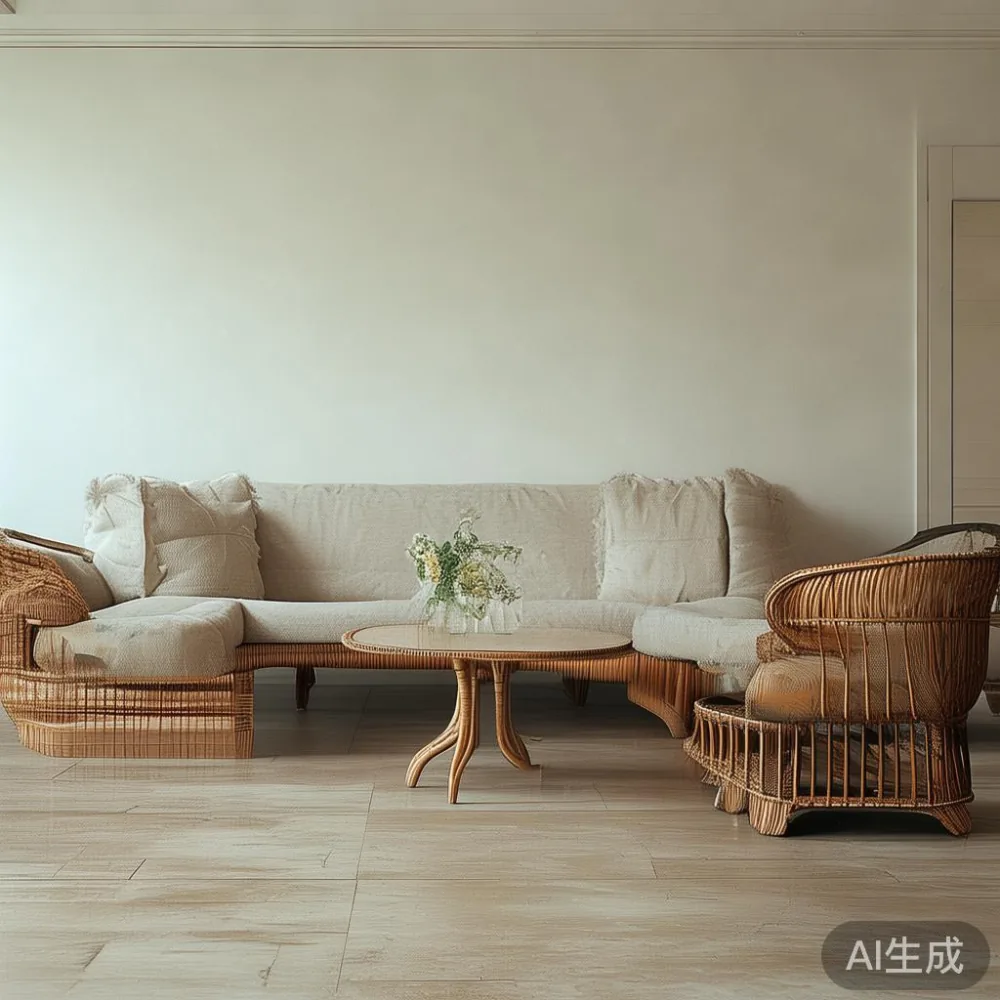
Yes, in three narrow cases. First, short-stay rental units where the furniture will be replaced within 18 to 24 months. Second, accent pieces that carry no load, such as a decorative marble table top on a powder-coated base, or a rattan side chair used purely as styling. Third, rattan furniture woven around a thin wooden frame, where the rattan itself is the hero material and the inner frame only needs to hold shape for a few years. In each case, the buyer is paying for looks, not lifespan.
The mistake is using veneer for the load-bearing pieces: the dining table you eat on every night, the bed frame that holds 200 kg nightly, the wardrobe doors that slide ten thousand times a year. Those three categories deserve solid construction. The first thing to check on any rattan furniture piece marketed as solid is whether the frame is solid wood or thin plywood wrapped in rattan. Plywood-core rattan frames can warp at the joints after two monsoon seasons.
How Should You Decide Between Italian Light Luxury and Scandinavian for the Bedroom?
Light luxury for bedroom styling breaks into three broad schools. Italian light luxury leans into darker walnut tones, brass detailing, marble accents, and a sense of restraint. American light luxury is more open, more breathable, often pairing oak with linen and curved silhouettes. Post-modern light luxury mixes materials with intention, layering marble table tops beside rattan furniture panels beside solid wood sofa frames in a single room.
Scandinavian for guest room setups goes the opposite direction: pale ash, white-washed oak, minimal hardware, and an emphasis on negative space. If your guest room doubles as a storage space, you want wardrobe depth of at least 60 cm to fit luggage sideways, and shelves spaced at 32 cm to hold folded linens. For shoppers researching how to choose Italian light luxury wardrobe options specifically, the checklist should include dovetail or mortise drawer joints, full-extension soft-close runners rated to 45 kg, and a backing panel at least 9 mm thick to keep the carcass square through humidity swings.
What Do Lift Widths and Corridor Corners Mean for Your Furniture Choice?
Singapore HDB lift doors measure between 800 mm and 1,100 mm wide, with cabin depths of 1,300 mm to 1,800 mm depending on the block era. A solid wood dining table that arrives in two halves, each half under 1,200 mm long, fits almost any lift. A pre-assembled 2 m wardrobe does not. That single fact influences material choice: solid wood that ships flat-packed and re-assembles on site beats veneer that arrives pre-built, because the flat-pack boxes measure under 1.8 m long and under 35 kg per carton, which a single delivery crew can carry up a stairwell if the lift is out of service.
Corridor corners in older blocks such as those in Tampines can tighten to 1.1 m at the turn. A flat-packed bed frame box at 210 cm x 32 cm x 18 cm rotates easily. A pre-built wardrobe at 240 cm x 60 cm x 220 cm does not. Delivery crews sometimes refuse to bring pre-built furniture past the lift, and the buyer pays a return-trip fee of S$80 to S$150. This is a quiet, recurring cost of cheap veneer furniture that arrives pre-assembled to keep factory labour costs down.
Is the MIDHILL Coffee Table Worth a Look for HDB Living Rooms?
For shoppers scrolling through MIDHILL coffee table review videos, the consistent feedback is on three points: the marble table top arrives in a separate crate from the solid wood base, the base uses through-tenon joinery, and the finish holds up under the daily wear of a coffee cup and a laptop. A 120 cm x 60 cm marble-top coffee table in light luxury style retails around S$1,800 to S$2,400 delivered to a Singapore door, which is competitive with mid-tier European brands at S$2,800 to S$3,500 and a clear step above what most Jurong mall retailers offer in the same dimensions.
The same Foshan origin story holds for buyers asking where to buy bed from MIDHILL. Direct factory ordering through api.midhill.co lets you specify panel thickness, finish tone, and hardware before shipment. A queen bed frame in ash with a fabric headboard panel runs roughly S$2,200 to S$2,600 delivered, with the 10-year structural warranty and lifetime refinishing bundled into the price.
What Does a Real Five-Year Cost Table Look Like Side by Side?
Here is a worked example covering a typical four-room HDB furnishing package: one six-seater dining table, one queen bed frame, one 2.4 m wardrobe, two nightstands, one coffee table, one three-seater solid wood sofa frame.
Veneer package (entry-level Jurong mall sourcing): Dining S$899, bed S$750, wardrobe S$1,800, nightstands S$220 each, coffee table S$420, sofa frame S$1,400. Subtotal S$5,709. Add GST at 9%: S$513.81. Add two delivery-and-disposal cycles over five years (assume one mid-cycle replacement of dining and bed, wardrobe replaced once): S$560 in extra deliveries and S$240 in disposal fees. Five-year total: S$7,022.81.
Solid wood package (Foshan factory direct, comparable sizing): Dining S$3,200, bed S$2,400, wardrobe S$3,800, nightstands S$480 each, coffee table S$2,000, sofa frame S$3,200. Subtotal S$15,560. GST at 9%: S$1,400.40. Add one delivery fee above the free-shipping threshold: zero. Lifetime refinishing visits: two at S$80 each. Five-year total: S$17,120.40.
The veneer package looks 60% cheaper on day one. Over five years, it is roughly 60% as durable and costs about 41% as much. If you stretch the same solid pieces over a 10-year horizon, the per-year cost of the solid package drops below S$1,800 a year, while the veneer package would need a third replacement cycle and would push past S$9,000 in cumulative spend.
Should You Plan for Resale Value When You Buy?
HDB resale value is set by location, MRT access, and renovation condition, not by furniture. But furniture affects how buyers feel during a viewing. A solid wood dining table staged with a linen runner and four chairs reads as care. A veneer table with peeling edges reads as deferred maintenance. The same principle applies to a wardrobe: a slab of solid timber with a soft-close mechanism signals investment; a hollow-core door with chipped laminate signals the next renovation will cost more.
For buyers who plan to sell their Punggol or Bedok unit within five years, the furniture choice also affects what they need to搬走 during the move. Solid pieces disassemble and reassemble cleanly. Veneer pieces often crack at the joints during a second or third move because the original glue lines have weakened, and the homeowner ends up paying disposal fees instead of moving fees.
Where Does Rattan Fit in a Solid-Heavy Buying Plan?
Rattan furniture is a useful complement, not a substitute, in a long-horizon solid wood plan. A pair of rattan armchairs in a balcony corner, a rattan headboard panel paired with a solid wood bed frame, or a rattan-fronted nightstand next to a solid timber wardrobe all work well, because the rattan carries no structural load and ages into a desirable patina. The trap is buying rattan furniture built on plywood frames, which is common in the S$300 to S$600 price band. Look for rattan woven onto a frame you can feel through the weave, with joints that show end-grain on the legs.
A practical room-by-room approach: solid for dining table, bed frame, wardrobe carcass, sofa frame, and coffee table base. Rattan or woven elements for accent chairs, headboard panels, and bedside detailing. Marble or stone for tabletops where the surface needs to handle hot pans and cold drinks daily. This split keeps the five-year replacement cycle off the structural pieces and lets the accent layers refresh every three to four years without major spend.
What Is the One Question Worth Asking Before You Click Buy?
Ask the supplier to specify, in writing, the thickness of the solid timber on every load-bearing face of the piece you intend to buy. If the answer is under 18 mm, you are looking at veneered or laminated construction regardless of how the marketing reads. If the answer is 18 mm to 25 mm with a named species (ash, oak, teak, rubberwood, walnut), you are looking at a piece that will outlast your HDB lease renewal cycle. Five years from now, the dining table will still be the dining table. The wardrobe will still hang straight. The bed frame will still hold the same two adults, the same mattress, and the same child climbing in for Saturday cartoons. That is the test the showroom price tag cannot answer, but the spreadsheet above does.